
A book review by Bill Utterback
In our initial Neurodiversity Support Ministry meeting, I shared a story about Mikey, the first child with autism I welcomed into my Sunday school classroom. I was immediately reminded of a foundational truth about neurodiversity: “If you have met one person with autism… you’ve met one person with autism.” The autism spectrum is vast. Every child, every youth, every adult offers a different truth, a different beauty, a different window. The window I shared with Mikey was a blessing, but I will need to find a different window to connect with the next person.
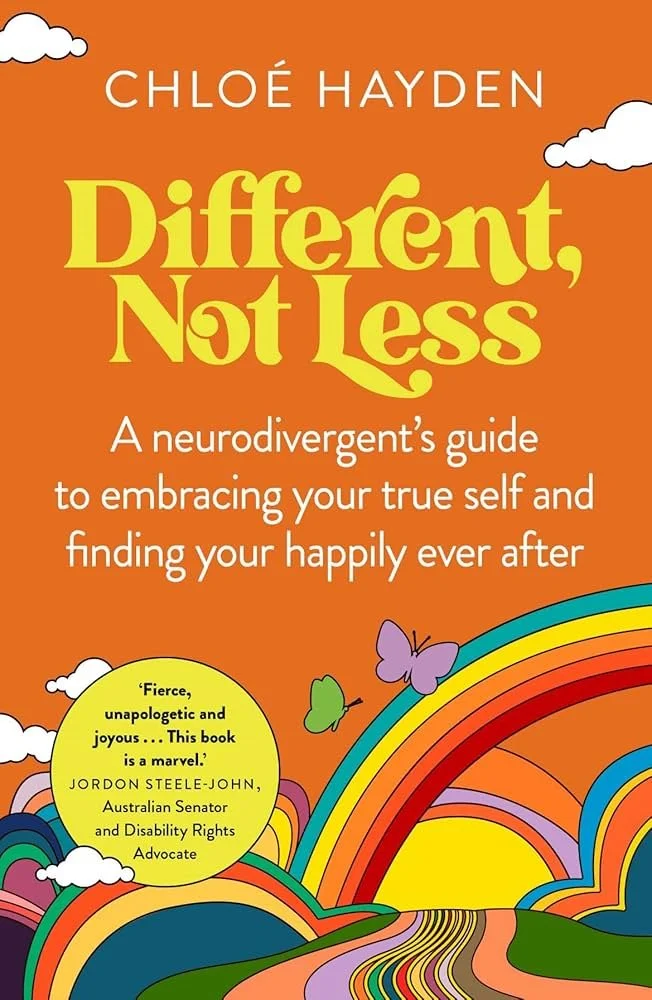
Books can serve as windows, introducing us to one more person’s truth. The SUMC NSM team intends to occasionally offer book reviews in this space as a small window to encourage neurodiversity awareness in our church family. A young adult friend with autism suggested “Different, Not Less,” a memoir written by Chloe Hayden, an Australian author/actress/advocate with autism who stars as “Quinnie” in “Heartbreak High” on Netflix. Her character is a high school student with autism. Sharon C., also a member of our NSM team, was also led to “Different, Not Less” by a friend with autism, and provided the book to our SUMC Library Committee. So it sits on our shelves, endorsed by two people from the neurodiversity committee.
Hayden is honest and practical, bruised and hopeful. Her window stretches from childhood through life as a young mother and working woman. She talks about the windows she’s discovered, and the rooms where no light seemed to enter. “I vividly remember writing a letter to God in my journal when I was five, asking why He’d made me so different… the idea of being different was terrifying and the realization that I might always be different led to tears, panic and a desperation for change.” Hayden writes that she was “selectively mute” through age 16. Conversations were difficult. School was difficult. Friendships were difficult. Church was difficult. She was sensitive to light. Sensitive to noise. Sensitive to smells. A haircut left her feeling like the trimmings that landed on her neck and shoulder “were prickling fire on my skin.” “Every time we attended a loud event, my brain would fizzle to the point of me passing out and having a seizure on the floor… I’d spend the following days in tears, vomiting and unable to stand.” She talks about masking, tried to hide her true self behind a mask that people would find more acceptable. She talks about depression, anxiety, and an eating disorder. “I was exhausted. The light in my body was fading and I had no desire to even be here anymore.”
Hayden was homeschooled for four years after school proved too demanding. But one teacher, Wendy, left an impression. “When I couldn’t attend school for days at a time due to anxiety and fear, she’d greet me with open arms, asking ‘How do you feel?’ and ‘What can I do for you?’ and saying ’I’ve missed you.’… Throughout school, Wendy was the only teacher who encouraged me to be me, she was the only one who showed me that I wasn’t only okay, but wonderful.” I feel like we have many people with “Wendy” perspectives at church. We are learning to ask the right questions and see the beauty in each person.
Hayden found a theater group that accepted and encouraged her, and a life partner who supports her. Hayden’s partner spent time researching autism online, then determined he needed to be patient and determined in learning about Chloe. “You are committed to the person… their particular brand of neurodivergence is an important part of who they are and why you love them,” her partner writes.
Hayden provides a list of “green flags” in relationships that might also serve a church family well: “they do research to better understand your position… they don’t make you feel like a burden… they show compassion… they encourage your special interests… you openly communicate with each other… it doesn’t feel like there’s a hierarchy and (they) respect each other… they are understanding of your needs.”
The author’s advice to neurodivergent people is this: “Surround yourself with people who boldly embrace difference… with humans of different body types, neurotypes, sexualities, genders, ethnicities… create a new normal.” Doesn’t that feel like the church Jesus wants, too?